.png)
Automating background checks? How to calculate ROI (and make your CFO smile)
Budgets are tight. HR investments are under more scrutiny than ever. So, how do you get your CFO to see the value in spending on background checks?
Frame your case around benefits, not features.
The best HR teams treat screening as a business tool. One that reduces risk, improves hiring quality and delivers measurable commercial impact. And your CFO? They’ll want these benefits quantified in the only language they know – money.
Here’s how to calculate ROI so you can build a business case for automation that wins over the shrewdest CFO.
In this guide:
- Why background checks are more than “just” compliance
- The hidden costs of bad hires
- How to convince your CFO to invest in a background check platform
- How to calculate ROI on background checks
Why background checks are more than “just” compliance
Unfortunately, there’s a lot about HR work that’s seen purely as a checkbox task. But with background screening?
Legal and regulatory compliance is the baseline.
Without a clear, efficient and consistent screening process in place, you’re more exposed to risky hiring decisions (that can lead to a whole lot of financial and reputational costs).
The hidden costs of bad hires
A bad hire affects more than that individual’s performance; it drags on time, team morale and operational costs. Here are four big financial impacts on the business.
1. Time lost on rehiring: recruitment, onboarding and training
You might find your average time spent on recruitment is already eye-wateringly excessive (especially if your manual screening process is stuck in 90s style Excel spreadsheets). But what about subsequent costs like the time spent on onboarding and systems and procedural training to get new hires ‘up to speed’?
Now, double it to account for the time (salaries) lost replacing each bad hire.
2. Potential compliance breaches and fraud
Whether you’re in a heavily regulated industry (like finance) or not, background checks help companies identify those red flags early before harm can be done. Failing to consistently check for criminal records, fraudulent behaviour, required skills and qualifications, and a history of violence, embezzlement, or theft exposes your business to heavy compliance fines, financial losses and employee or customer litigation due to unlawful acts against them.
3. Employee turnover
When you’re not asking the right questions, you can’t make informed hiring decisions, so you can end up hiring people who don’t align with your values and ‘way of doing things’. They may feel that friction and leave quickly (if you don’t ask them first) or they may negatively impact the morale, engagement and culture of existing employees who might then leave for greener pastures.
This can lead to:
- termination costs
- backfilling costs
- disruption to team outputs / productivity
4. Reputational damage
What happens when the media, investors, stakeholders and customers catch wind of an employee’s misdemeanours, be it fraud, theft or violence? Worse still when it is discovered to be from screening and compliance gaps and shortcuts that failed to detect previous offences.
These costs all stack up quickly.
What manual reference checking actually costs you
Manual reference checking has a way of hiding its true cost. The time on the phone looks manageable. It's the hours around it where things get expensive.
Start with the time maths
A manual reference check takes around 30 minutes per call, and most roles need two to three referees. That puts you at 60 to 90 minutes of talk time per candidate, assuming every referee picks up first go, which they rarely do. Add the scheduling emails, the voicemails, the redials and the typing up of notes, and references for one candidate can easily consume two to three hours of someone’s working week.
From there, the cost calculation is simple. It’s hourly salary cost × hours per candidate × annual hiring volume.
Say the team member running your checks earns $80,000 a year, which works out to roughly $40 an hour. At two to three hours per candidate, every set of references costs around $100 in salary before anything goes sideways. Hire 200 people a year and you’re spending about $20,000 annually on phone tag. You can plug your own numbers into our ROI calculator to see exactly where you land.
Then add the costs that never hit a timesheet
Some of the most expensive parts of manual reference checking rarely show up as line items. When a referee goes quiet halfway through, the hiring manager starts the chase again and the clock resets. Feedback captured by hand or from memory are hard to compare across candidates, and a weak record if a hiring decision is ever questioned. And because every hiring manager may ask the referee different questions, you end up with results that are difficult to consistently compare. The biggest hidden cost, though, is candidate drop-off. While your team plays phone tag, your shortlisted candidate may be fielding competing offers. A slow reference check can cost you the hire itself, along with the entire recruitment spend that got you to that point. Speed matters here in a way that’s easy to underestimate. When Fletcher Building automated screening with Checkmate, time-to-offer dropped from 80 days to just over 30.
Manual vs automated, side by side
Set all of that against the wider figure: a bad hire can cost between 15 and 21 per cent of that employee’s salary (per Robert Half), that’s around $18,000 for a mid-level role on $90,000. Manual checking feeds that risk.
When checks are slow and tedious, they tend to get rushed, scaled back, or skipped entirely for the “obvious” strong candidate. Automating reference checks makes the thorough option the easy one, and that’s the most affordable and accessible risk reduction available to most hiring teams.
How to convince your CFO to invest in a background check platform
Influence starts by understanding what matters to your audience. In this case, your CFO might see background screening as an unnecessary financial burden on the business. So, they probably aren’t interested in the perfect process.
It’s more likely their priority will be to find a solution that reduces risk, controls costs, and improves operational performance.
When positioning your argument, you’ll want to focus on these key points:
- background screening reduces rework, hiring delays, and risk exposure
- automation saves time on messy admin and frees up your team for high value work
- stronger, informed hiring decisions lead to lower turnover
- full visibility of checks (and ease of access) assists auditing, reporting and business reviews.
Now, you’ll want to crunch the numbers that support your position.
How to calculate ROI on background checks
Automated background checks aren’t a fluffy nice-to-have. They produce real, tangible impact across the business, saving time and costs, and improving the quality of hires.
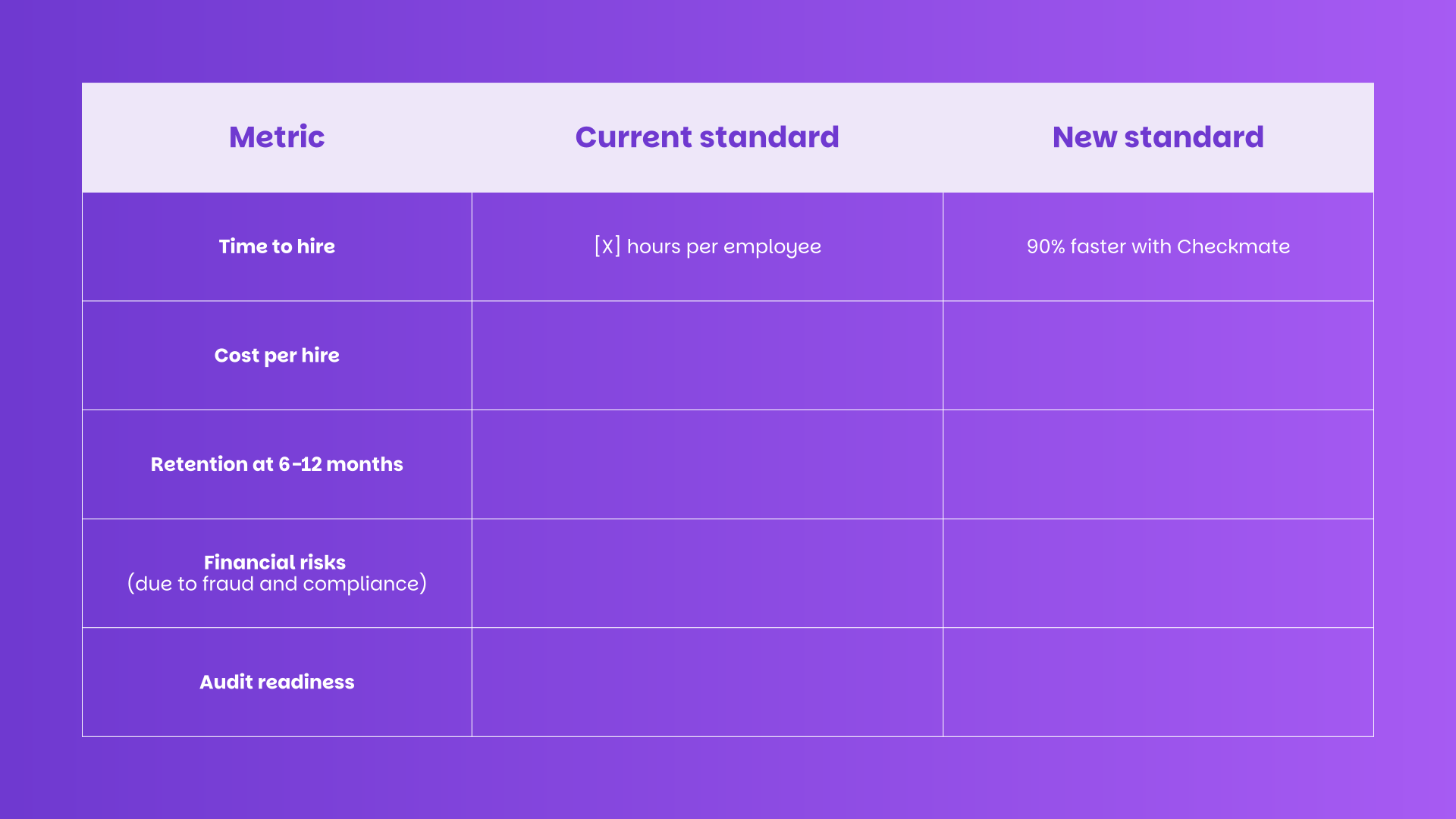
Here’s our simple framework for measuring the ROI on automated background checks that will make even the most prudent CFO smile.
Time to hire
Streamlined screening processes speed up your hiring timeline and get qualified talent in seats sooner. Calculate the total hours spent on recruitment and compliance checks (including the endless hours playing phone tag with referees!) and compare to time saved with automation.
[See how much time automation can save you with our ROI calculator]
Retention at 6-12 months
Calculate the number of people hired in the past 12 months, by how many remained at six- and twelve-months post commencement (even better if you’ve been tracking this for a few consecutive years).
How much of your attrition rate is down to poor (or slow!) hiring decisions?
Cost per hire
While estimates vary, a bad hire can cost an employer between 15 and 21 per cent of that employee’s salary. For example, a mid-level employee earning $90,000 per year might cost $18,000 to replace, whereas a senior executive earning $200,000 per year might cost $40,000 to replace. This doesn’t include termination payouts and golden handshakes.
Calculate your average turnover rate first and use this figure to guide how much money you’re currently wasting on bad hiring decisions.
Financial risks
Probably the greatest financial risk to the business is that of non-compliance and fraud. We recommend you:
- Conduct a fraud risk assessment and identify the roles that pose a risk to your business (use a risk matrix). Note: you may already have an employee due diligence program in place.
- Assess the likelihood of fraud and corruption and the perceived consequences.
- Quantify the financial losses from fraud should a poorly screened employee behave unlawfully.
- Quantify the associated regulatory fines from non-compliance and poor record-keeping.
- Consider quantifying reputational damage and litigation.
If there have been previous instances of non-compliance or fraudulent behaviour in your organisation, you may already have figures you can draw from.
Audit readiness
Calculate and compare the time and costs involved in responding to internal and external auditing requirements manually vs. an automated, export-ready dashboard.
Automated background checks return money and time to the business
The best way to win over your CFO and convince them to invest in background screening is always to talk money. Use our simple framework to crunch the numbers around:
- Average cost per hire
- Turnover or early attrition rates
- Time lost due to rehiring or manually intensive background checks (and salary equivalent)
- Financial risks and costs from bad hires and non-compliant processes
Remember to support your case with internal data and benchmarks where possible or reference industry averages when calculating your ROI.
Download our HR Business Case template for a step-by-step guide to building your business case for our background screening platform.
.png)
.png)
.png)

