How to stay compliant when hiring visa holders in Australia
If you’ve ever hired a New Zealander to work in Australia, there’s a good chance you’ve hired a visa holder. New Zealand citizens who arrive on their passport are granted a Special Category visa (subclass 444) at the border. There’s no application form, so it’s easy to forget it even exists.
It’s likely the simplest visa you’ll ever deal with as an Australian employer. Like Australian citizens and permanent residents, Special Category visa holders can work without conditions. Most other visas come with conditions, an end date, or both.
Staying compliant when you hire visa holders in Australia comes down to two jobs: confirm a person’s right to work before they start, then keep confirming it for as long as they work for you. The first job takes a few minutes, but the second is where it gets harder, because visas expire and conditions change, and nobody necessarily calls HR to mention it each time.
If you look after HR, people, or workforce compliance in a business that employs (or places) visa holders, this one’s for you.
Right to work checks in Australia: what do employers need to know?
If you employ people in Australia, it’s on you to make sure they’re legally allowed to work. Under the Migration Act 1958, it’s a criminal offence to employ, refer, or contract a non-citizen who doesn’t have the right to work, or to let a visa holder work in breach of their conditions, and penalties apply per worker. They also apply when a recruitment agency or labour hire company supplied the person, so outsourcing the hire doesn’t outsource the risk.
The law does give you a clear way to protect yourself. Section 245AB says you’re covered if you take “reasonable steps at reasonable times” to verify a worker’s status, including by using a government-prescribed computer system. Home Affairs points employers to VEVO for this. The phrase worth noting is reasonable times. It’s plural, which is why a single check at hiring isn’t much protection for someone on a temporary visa.
Intent also matters less than you might hope. For civil penalties, nobody has to prove you knew or meant to do anything.
So who actually needs checking? In a sense, everyone, because you need to know which group each person falls into. Australian citizens, permanent residents, and New Zealand citizens on a Special Category visa can work without conditions. Visitor visas and Electronic Travel Authorities (ETAs) don’t allow work at all. Everyone else sits somewhere in between. Some temporary visas, like the Temporary Graduate visa (subclass 485), allow unrestricted work but still expire.
One common shortcut doesn’t hold up, either. A Medicare card, tax file number, or driver’s licence isn’t proof of work rights.
How do you check a visa holder’s work rights before they start?
The standard tool is Visa Entitlement Verification Online (VEVO), a free service run by the Department of Home Affairs. It shows the visa a person currently holds and the conditions attached to it. You’ll need the visa holder’s permission before you run the check, which is easy to build into your offer or onboarding paperwork.
Two habits make the check count. First, read the conditions as well as the yes-or-no answer. A visa can allow work and still cap the hours or tie the holder to one employer or role. Second, keep a dated record of every check. If anyone ever asks what reasonable steps you took, that record is your answer.
The visa conditions that catch employers out
A handful of visa types come up again and again in Australian workplaces, and each has a rule that’s easy to trip over.
Student visas
Student visa holders can work up to 48 hours a fortnight while their course is in session, and unlimited hours during official course breaks. The cap covers all their jobs combined. A student working 30 hours a fortnight for you and 25 for a cafe down the road is over the limit, even though neither roster looks unusual on its own.
The student’s visa is the one most at risk, but an employer who lets them work in breach of their conditions can face penalties too. Asking about other jobs at onboarding, and again each term, protects you both. You may have seen talk of the cap rising to 60 hours. That’s an Opposition policy proposal, not law, so 48 still applies.
Working Holiday Makers
Working Holiday Makers (subclasses 417 and 462) generally can’t work for one employer for more than six months, under visa condition 8547. Some work is exempt (including roles in hospitality and tourism, aged and disability care, childcare, health and agriculture, or work split across different locations), and the visa holder can ask Home Affairs for permission to stay on longer. That request has to go in before the six months are up. If it does, they can keep working for you until they get a written decision.
The six-month clock resets with each new Working Holiday visa, so track start dates person by person.
Sponsored skilled workers
Many sponsored skilled workers now hold the Skills in Demand visa (subclass 482), which replaced the Temporary Skill Shortage visa on 7 December 2024. These visas come with conditions about the work the holder can do, and if you’re the sponsor, you have your own set of obligations to Home Affairs on top.
Bridging visas
Bridging visas keep someone lawful while Home Affairs decides another visa application. Work rights on a bridging visa vary, and VEVO may not show a fixed end date. That’s exactly why it’s worth re-checking bridging visa holders more often. Every three months is a sensible rhythm.
Why one check isn’t enough
Visas aren’t set in stone after you hire someone. They expire, or get replaced by a new visa with different conditions, and occasionally they get cancelled. None of that shows up in your HR system by itself.
Which is how so many businesses end up with the spreadsheet. You know the one: a column called “Visa expiry” and a reminder set by someone who may have since left the team. It was accurate the day it was built. At ten visa holders, that’s manageable. At a few hundred across multiple sites, it’s a liability.
The gap tends to surface at the worst possible moment. An auditor or a major client asks for proof of current work rights, and the business finds out some checks haven’t been re-run in years. For labour hire providers the pressure doubles, because you may need to prove compliance to several client businesses at once.
It’s sharpest wherever visa holders make up a big share of the roster and people come and go quickly. That describes a lot of retail, hospitality, construction, agriculture, and aged care. If you use contractors as well as employees, the same obligations reach them too, which we cover in screening contractors vs permanent staff.
What happens if you get it wrong?
Penalties are set in penalty units, and from 1 July 2026 one penalty unit is worth $364. For allowing someone to work without the right to, or in breach of their visa conditions, a company faces a civil penalty of up to 1,200 penalty units ($436,800) for each worker. Individuals, including sole traders, face up to $87,360 per worker. Five workers on the wrong side of their visa? Do the maths. The criminal offences carry up to two years’ imprisonment, rising to five years for aggravated offences.
The law was overhauled on 1 July 2024, mostly to protect visa holders. It’s now a specific offence to coerce or pressure a visa holder into breaching their work conditions. Visa holders also have the same workplace rights and protections as any other employee under the Fair Work Act 2009, whatever their migration status.
For a business that’s trying to get this right, the part worth knowing is the prohibited employer scheme. The government can bar employers who seriously, deliberately, or repeatedly break migration or workplace laws from taking on more temporary visa holders for a set period, and their business name and ABN are published on the Australian Border Force’s public Prohibited Employer Register. Repeated breaches are exactly what a consistent checking process protects against.
What good ongoing visa compliance looks like
None of this needs a dedicated compliance department. It needs a system that remembers, so people don’t have to.
- One register for everyone: every worker’s work rights status in one place, with the date and result of their most recent check.
- A re-check rhythm matched to the visa: people with no work conditions need checking once. Temporary visa holders need checking before their visa ends and at sensible points in between, and bridging visa holders more often again.
- Dates that reflect the conditions: a six-month date for each Working Holiday Maker (unless their work is exempt), and hours tracked for students during term.
- A named owner: one person responsible for acting when a check falls due or a result changes.
- Contracts that pass the obligation down: Home Affairs suggests including a clause in labour hire contracts that requires the provider to check visa conditions through VEVO.
How Checkmate helps you stay compliant with visa holders
Checkmate keeps the first check and every check after it in one place, attached to the same person’s record.
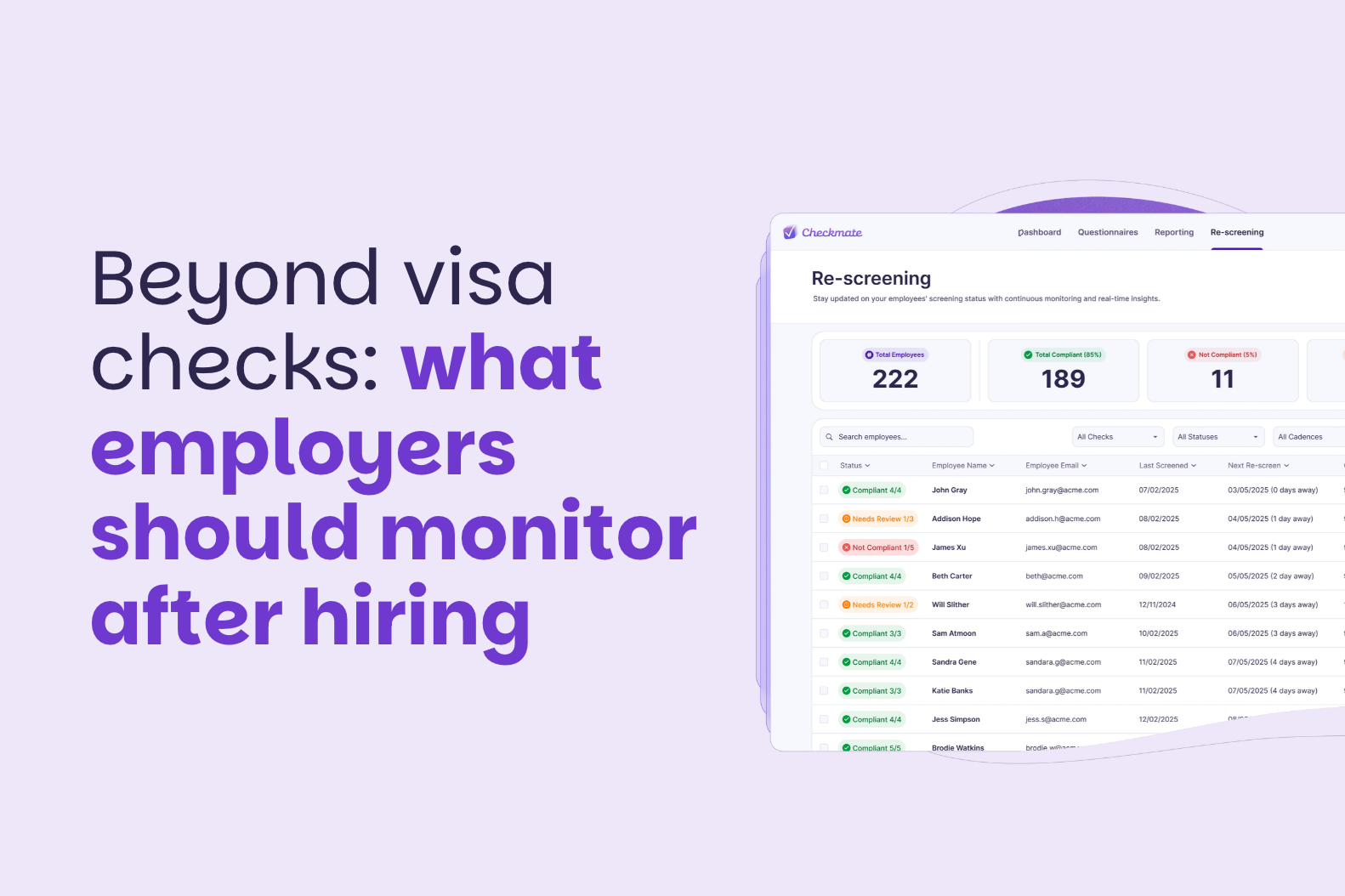
When you hire, the Australia Work Entitlement and Visa Check confirms visa status and work rights through the Department of Home Affairs’ VEVO system, as part of your pre-employment screening. Once someone joins your team, ongoing compliance lets you set re-check rules by visa type, so you always know when each temporary visa holder is due for another check, instead of relying on someone to remember. If a re-check shows a change to someone’s visa status or conditions, it’s flagged so your team can act on it.
Because it’s one record from offer to exit, there’s no re-keying details or switching between a screening tool and a separate visa tracker. Book a demo to see how it fits your workforce.
Frequently asked questions
Do New Zealand citizens need a visa to work in Australia?
New Zealand citizens who arrive on a New Zealand passport are granted a Special Category visa (subclass 444) on arrival, subject to health and character requirements. It’s a visa, but it carries no conditions on work, so they can work in Australia on the same footing as citizens and permanent residents. Employers should still confirm and record each new hire’s citizenship or visa status as part of a standard right to work check.
Is a VEVO check a legal requirement for Australian employers?
The Migration Act doesn’t mandate one specific tool, but it protects employers who take reasonable steps at reasonable times to verify a worker’s status, including using a government-prescribed computer system. The Department of Home Affairs points employers to Visa Entitlement Verification Online (VEVO), a free service, for this. A dated VEVO record is the simplest evidence that an employer checked properly.
How often should you re-check a visa holder’s work rights?
There’s no single legal interval. The law expects reasonable steps at reasonable times, so the right cadence depends on the visa. Temporary visa holders should be checked before their visa ends and at regular points in between. Bridging visa holders, whose visas may show no fixed end date, are worth re-checking more often, for example every three months. Citizens, permanent residents, and New Zealand Special Category visa holders generally need checking once.
How many hours can a student visa holder work in Australia?
Student visa holders can work up to 48 hours per fortnight while their course is in session, and unlimited hours during scheduled course breaks. The limit applies across all their jobs combined, so hours worked for another employer count. Students in a master’s by research or doctoral program can work unlimited hours once their course starts. A Coalition proposal to lift the cap to 60 hours is not law.
How long can a Working Holiday Maker work for one employer?
Working Holiday Makers on subclass 417 or 462 visas can generally work for one employer for up to six months, under visa condition 8547. Some types of work are exempt, including hospitality, tourism, aged care and other critical sectors, and the visa holder can request permission to work longer, provided the request goes in before the six months end. The six-month period starts again when they’re granted a new Working Holiday visa.
What documents don’t prove someone’s right to work in Australia?
A Medicare card, tax file number, or driver’s licence doesn’t prove work rights, even though all three are common onboarding documents. For non-citizens, the reliable approach is a VEVO check through the Department of Home Affairs, run with the worker’s permission and recorded with the date. That record is what shows an employer took reasonable steps if the question ever comes up.
Is a business responsible for visa workers supplied by a labour hire company?
Yes. Penalties for allowing illegal work in Australia apply per worker, including workers sourced through recruitment or labour hire companies. Home Affairs suggests adding a clause to labour hire contracts requiring the provider to check workers’ visa conditions using VEVO and to treat them fairly under Australian law. Keeping your own record of those checks adds a second layer of protection.
What is a prohibited employer in Australia?
A prohibited employer is a business the Australian Government has barred from taking on additional temporary visa holders for a set period, after serious, deliberate, or repeated breaches of migration, workplace, or related criminal laws. The power came in with laws that commenced on 1 July 2024. Prohibited employers’ business names and ABNs are published on the Australian Border Force’s Prohibited Employer Register.
What are the penalties for employing someone without work rights in Australia?
From 1 July 2026, a company that allows someone to work without the right to, or in breach of their visa conditions, faces civil penalties of up to $436,800 per worker. Individuals face up to $87,360 per worker. Criminal offences carry up to two years’ imprisonment, or five years for aggravated offences. Separate penalties apply to coercing visa holders and to prohibited employers who take on new temporary visa holders.
How can high-turnover businesses like retail and hospitality keep visa checks fast?
Build the work rights check into the same onboarding flow as your other pre-employment checks, so candidates complete everything once and nothing waits on a separate system. Then set re-check dates at the point of hire, based on each person’s visa. Checkmate runs the Australian work entitlement check alongside other screening checks and carries the same record into ongoing monitoring.