What do the Heavy Vehicle National Law changes from 1 August 2026 mean for employers?
Updated November 2026
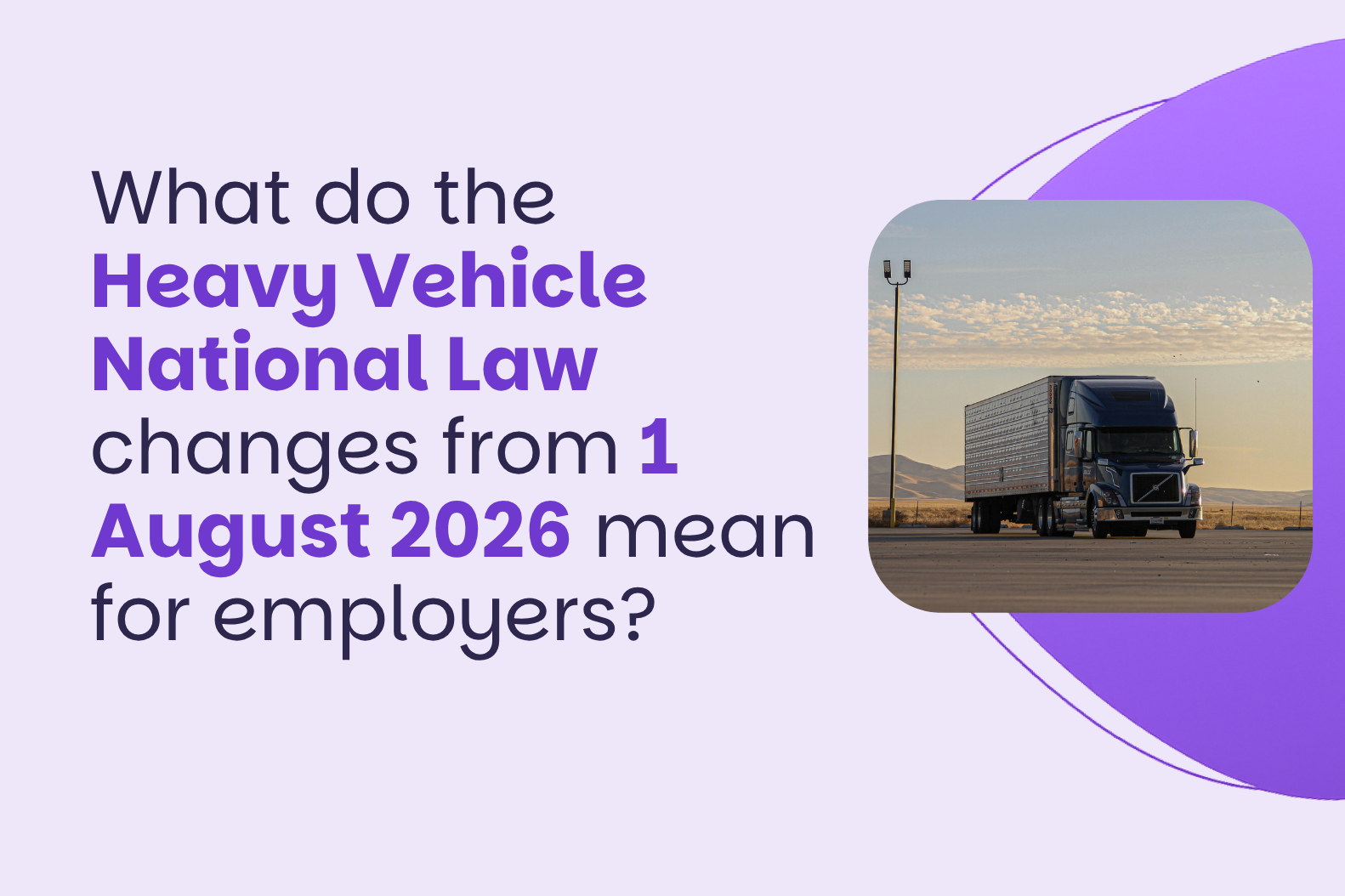
Every business with drivers has had the call. Someone’s sick, injured or just not quite right, and there’s a delivery or a job that can’t wait. Until recently, heavy vehicle law only stepped in if that driver was fatigued. That’s now changed.
On 1 August 2026, the Heavy Vehicle National Law had its biggest rewrite since it began, and one key piece of it landed on the businesses that employ and roster drivers. Anyone employed to drive a vehicle over 4.5 tonnes must now stop if illness, injury, medication or stress affects their ability to drive safely, and the law backs them when they do. As an employer, you need to make sure your business never puts a driver in that position, and you need to be able to show a regulator how you consistently check.
The changes apply in New South Wales, Victoria, Queensland, South Australia, Tasmania, and the ACT, but not in Western Australia or the Northern Territory, which run their own heavy vehicle laws.
If your business employs or rosters people who drive heavy vehicles, here’s what’s changed and what it means for you.
What changed in the Heavy Vehicle National Law on 1 August 2026?
The amended HVNL changes how heavy vehicle businesses get accredited, how much their vehicles can carry, and what they pay when they get it wrong. It also introduces a new duty about the person behind the wheel. Queensland Parliament passed the Heavy Vehicle National Law Amendment Act 2025 in November 2025, and it came into force on 1 August 2026. Queensland hosts the law, and the other participating states and territories adopt it.
For fleets and operators, the main changes are:
- Accreditation: a new scheme built around safety management systems replaces the old National Heavy Vehicle Accreditation Scheme (NHVAS)
- Work diaries: updated rules for recording work and rest
- Mass and length: higher general mass limits, and a maximum length of 20 metres (up from 19) for eligible combinations
- Penalties: a reworked penalty structure, with higher penalties for safety breaches and lower ones for most paperwork errors
The NHVR’s HVNL reform implementation page has the full list.
The change that matters most for employers is the new unfit to drive duty. Before August, the law only prohibited driving while impaired by fatigue, and only in fatigue-regulated vehicles, which broadly means those over 12 tonnes and certain buses. Now a person must not drive any heavy vehicle over 4.5 tonnes while impaired by fatigue or “otherwise unfit”. That lower threshold brings in rigid trucks and large vans that fatigue rules never covered before. “Unfit” also goes well beyond tiredness. It includes physical and mental health conditions, illness, injury, and the effects of alcohol, drugs or medication.
Does the unfit to drive duty apply to the driver or the business?
It applies to both, in different ways. The driver carries the offence, and the business carries the duty to make sure it never comes to that.
For drivers, the amended section 228 of the HVNL makes it an offence to drive a heavy vehicle while fatigued or unfit. It also gives them clear legal footing to refuse a shift, or to stop partway through one, if they’re not fit to drive.
For employers, the obligation comes through Chain of Responsibility (CoR), the part of the HVNL that makes everyone who influences a driver’s work share responsibility for safety. If you employ drivers, roster them or schedule their work, you’re part of that chain. Under CoR’s primary duty, you have to do everything reasonably practicable to make your transport activities safe.
The NHVR’s guidance on the new duty spells out what that means in practice. Your business needs to:
- make sure rosters, deadlines and pay don’t cause or encourage anyone to drive while unfit
- check drivers are fit to drive before they get behind the wheel
- make it safe for drivers to stop when they need to
- act when a driver tells you they’re unfit, and never require them to drive anyway
You don’t have to have a crash to be prosecuted. The NHVR can act against a business that hasn’t taken reasonable steps, even if nothing has gone wrong yet. Directors and senior managers also carry a personal duty to make sure the business is meeting its obligations.
The NHVR is already taking this seriously. In June 2026, a court upheld a $1.2 million fine against a Sydney earthmoving company over a fatal crash in 2021. The driver had serious long-term health issues, and the NHVR said the company lacked adequate policies to make sure its drivers were fit for duty. The court also ordered that every driver get medical clearance before driving again.
The new duty also sits alongside your existing work health and safety obligations rather than replacing them.
What are the penalties under the amended HVNL?
Penalties increased for about 50 offences, some of them doubling, and 21 came down, nearly all of those administrative, according to figures the NHVR gave Big Rigs in June. The base penalty for driving while fatigued or unfit has more than tripled, and is now $20,000.
Penalties had already moved once this year with the annual indexation on 1 July, so any figure from a 2025 fact sheet is now doubly wrong. The table shows the court maximums from the NHVR's penalty schedule for 1 August 2026 to 30 June 2027. Where an infringement notice is available, the amount is 10% of the maximum court penalty. More serious offences must be dealt with in court.
For anyone driving a vehicle between 4.5 and 12 tonnes, driving while fatigued or unfit is an offence that didn’t exist before August.
| Offence | Maximum penalty from 1 August 2026 | What changed |
|---|---|---|
| Driving a heavy vehicle while fatigued or unfit (the driver) | $28,230 and three demerit points | Base penalty up from $6,000 to $20,000, and the duty now covers vehicles from 4.5 tonnes instead of 12 |
| False or misleading work records, and related tampering | $28,230 | Doubled from $14,120 |
| Employer, operator, or scheduler fatigue duty | $14,120 | Up from $8,480 |
| Primary duty, most serious category | $4,230,550 for a corporation; $436,850 or five years' imprisonment for an individual | Indexation only |
Source: NHVR, Schedule of Infringement Penalties and Demerit Points, 1 August 2026 to 30 June 2027.
Do you need to check driver licences under the HVNL?
The Act doesn't tell you to run a licence check, but the NHVR's regulatory advice on fitness to work comes close. It lists pre-employment background checks as a reasonable intervention for parties in the chain and names the checks it means. Reference checks and police checks are on the list, and so are medical screening and checks of licence, driving record, and qualifications. The same advice notes that some states require heavy vehicle drivers to pass a fitness to drive medical before they start and then periodically, under the Austroads Assessing Fitness to Drive standard. The NHVR’s unfit to drive guidance adds that being medically fit for a licence doesn’t mean a driver is fit to drive on any given day.
Each check does a different job. References from people who have watched the candidate drive for a living tell you how they drive. A police check matters where the cargo or the site calls for one. The licence check confirms the driver holds the right class of licence and that it’s current, and the medical, where your state requires one for that class, is the regulator's baseline for fitness, with the new duty covering every day in between. We've written before about screening for transport and logistics roles and about how long each background check takes in Australia.
On re-checks, Checkmate's view is that an annual licence re-verification is a sensible rhythm for most operators, with medicals on whatever cycle your state sets for the licence class. One logistics operator we spoke to recently is moving to re-check their entire driver workforce every year for exactly this reason. A licence that was valid at hire tells you about hire day. It says nothing about the suspension that might have come through months later. You should record what you checked and when, person by person.
How does Checkmate fit in?
The checks the NHVR lists are the ones you'd typically run on any driver at hire. The harder part is running them again a year later, for every driver, and being able to prove it. Checkmate runs the reference and criminal history checks at hire, alongside ID verification, and verifies the driver licence details the candidate supplies. After hire, Ongoing Compliance lets you set re-check rules by check type on the same person's record and flags any change so your team can act. That means the annual licence re-check sits in one place with the rest of that driver's history. If you already re-check visas and work rights, licences are the natural next addition, and we cover that in what employers should monitor after hiring.
FAQ
What counts as being unfit to drive under the HVNL?
A driver is unfit if, at that moment, their health or fitness isn't good enough to drive the heavy vehicle safely. The NHVR's examples include a medical episode such as low blood sugar, a back injury that affects concentration, flu, psychological or emotional distress, a mental health condition, and the effects of alcohol, illicit drugs, or a new medication. Fatigue still counts and keeps its own rules. The test is how the driver is on the day.
What should an employer do if a driver says they’re unfit to drive?
Take them off the road and act on it. Under the HVNL, a driver who tells you they’re unfit is meeting their legal obligation, and the NHVR says the employer is then responsible for taking appropriate action. You can’t require them to start or keep driving, and doing so would breach the primary duty. It’s worth having a clear stand-down process ready before you need it, including who covers the shift and how the driver’s fitness is checked before they return.
Does the unfit to drive duty apply to trucks under 12 tonnes?
Yes. The duty covers every heavy vehicle over 4.5 tonnes gross vehicle mass, which takes in rigid trucks and large vans that have never been fatigue-regulated. Work diary and work-and-rest-hours rules still attach mainly to fatigue-regulated vehicles, usually those over 12 tonnes and certain buses, so a smaller vehicle can be inside the fitness duty without being inside the diary rules.
Do the HVNL changes apply in Western Australia or the Northern Territory?
No. Western Australia and the Northern Territory don't take part in the Heavy Vehicle National Law and run their own heavy vehicle rules, so the 1 August changes don't apply to work done there. If your fleet crosses between a participating state and WA or the NT, your drivers are working under two sets of rules.
Sources
- HVNL reform implementation, National Heavy Vehicle Regulator, accessed November 2026
- Unfit to Drive, National Heavy Vehicle Regulator, accessed November 2026
- Regulatory Advice: Fitness to work, National Heavy Vehicle Regulator, accessed November 2026
- Schedule of Infringement Penalties and Demerit Points, 1 August 2026 to 30 June 2027, National Heavy Vehicle Regulator
- Penalties and infringements, National Heavy Vehicle Regulator, accessed November 2026
- Heavy Vehicle National Law Amendment Act 2025, Queensland legislation
- Towards an updated Heavy Vehicle National Law, National Transport Commission, accessed November 2026
- 50 penalties will go up and 21 penalties will go down under the new HVNL, Big Rigs, 5 June 2026
- NHVR highlights fit for duty requirements after successful prosecution, National Heavy Vehicle Regulator, 3 July 2026
- Assessing Fitness to Drive, Austroads