Beyond visa checks: what employers should monitor after hiring
For a long time, background screening has been treated as a box to tick before someone starts. But risk exposure doesn’t end at onboarding (so your checks shouldn’t either). Most organisations now know they need to keep re-checking visa status, but the conversation often stops there, even though licences, registrations, sanctions lists and criminal history can all change during someone’s employment too.
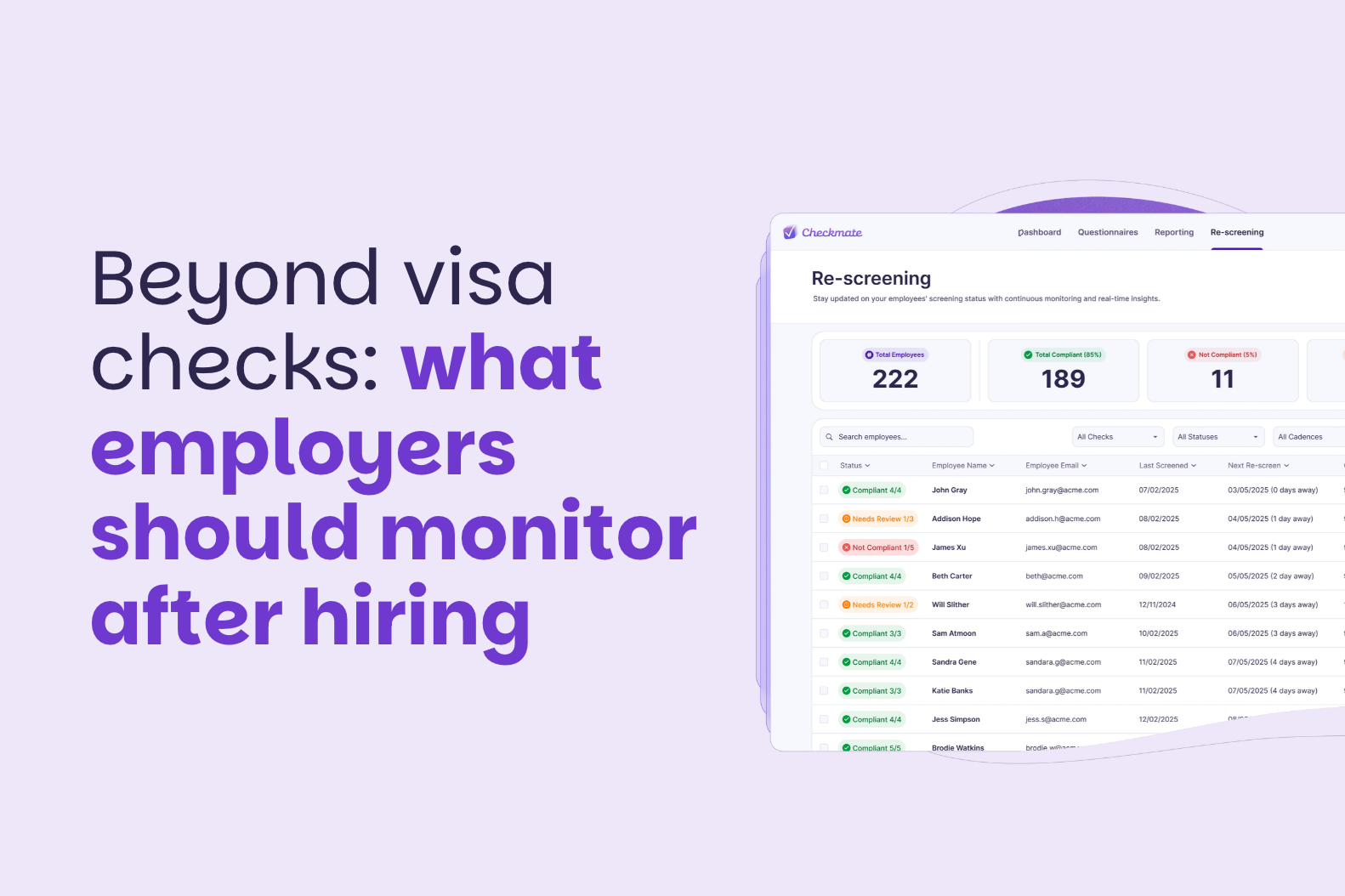
Ongoing compliance monitoring (sometimes called post-hire compliance monitoring) closes that gap by re-checking what matters on a regular schedule throughout the full employee lifecycle, so you hear about a change while you can still act on it.
This guide explains how workforce compliance monitoring works, what it covers in addition to visa checks, and how to keep a clear view of compliance across your whole workforce.
In this guide:
- Why a fixed pre-hire screening program exposes your business to risk
- What is workforce compliance monitoring and what does it cover?
- What should employers keep monitoring besides visa status?
- Do I need to re-check employee licences and certifications after hiring?
- How can we prove we’re compliant right now?
- Can one platform monitor visa status, licences and criminal history together?
Why a fixed pre-hire screening program exposes your business to risk
Pre-employment checks are a snapshot, accurate only at that point in time. Work rights change, visas can be cancelled or have new conditions attached, licences lapse, and new offences can come to light long after someone’s start date.
Add to that evolving compliance frameworks and government legislation that bring greater accountability and governance (and more pressure on you not to let something fall through the cracks). Visa breaches are the most visible example, with penalties that apply per worker and can reach directors personally. We’ve broken down what a visa compliance breach actually costs in Australia separately. Lapsed registrations, missed screening renewals and sanctions hits carry their own consequences, especially in regulated industries.
It happens more often than you’d think. In 2026, a NSW childcare provider was fined $20,000 after a staff member’s Working with Children Check was suspended and they were later prohibited from the sector. The provider asked the worker about the suspension but didn’t check with the regulator, and they stayed on for most of a year. In aged care, a worker subject to a national banning order picked up shifts at two different providers within weeks of the ban taking effect. That’s why the regulator expects providers to check its banning order register regularly, not just at hiring.
Ongoing compliance monitoring tracks risk indicators across the employee lifecycle, removing those blind spots.
What is workforce compliance monitoring and what does it cover?
Workforce compliance monitoring is the practice of regularly re-checking relevant data sources after someone’s been hired, and triggering automated alerts that notify you of changes or new risks. It doesn’t need to be a full (continuing) re-run of your pre-hire screening, which can be time-consuming and expensive. Instead, you re-check the right things for each role, as often as the risk calls for.
Key risk areas it can cover:
- right-to-work and visa status (via VEVO in Australia)
- criminal history, re-screened at set intervals for higher-risk roles
- AML, sanctions and exclusion lists
- professional licences, registrations and qualification expiries
- Working with Children and NDIS Worker Screening checks
- credit checks
- motor vehicle records
Ongoing compliance monitoring is beneficial for any organisation, and essential for those in regulated industries like aged care, healthcare and financial services, or with large numbers of visa holders across sites, shifts and labour hire arrangements.
What should employers keep monitoring besides visa status?
Visa monitoring is usually where employers start, and if you’re still setting that up, our guide to visa compliance costs covers how often to re-check and why. But to mitigate all other ongoing compliance risks, employers should continue monitoring:
1. Professional licences and industry standards
This covers professional registrations with governing industry bodies (e.g. AHPRA for health practitioners, or teacher registration), licences and tickets (e.g. Responsible Service of Alcohol), and checks for working with vulnerable people, like Working with Children and NDIS Worker Screening. Monitoring can also pick up disciplinary actions, suspensions or revocations that affect the validity of credentials, not just expiry dates.
2. AML and sanctions watchlists
Anti-Money Laundering, sanctions and exclusions watchlist monitoring can flag an employee at any time, whereas manual rechecks are scheduled to a pre-set timeline and may leave you with information gaps in between. A compliance breach in heavily regulated industries, like aged care and finance, can trigger significant penalties.
3. Criminal history re-screening for higher-risk roles
Re-screening existing employees for new criminal records and role-relevant offences throughout their tenure (e.g. drink driving for couriers, or assault for roles working with vulnerable people) helps ensure safety and maintain employee and customer trust. In Australia, a national police check only reflects records on the day it’s issued and has no standard expiry, so it’s up to you to decide how often to re-run it based on how risky the role is. For people working with children or NDIS participants, there’s an extra safeguard: Working with Children and NDIS Worker Screening clearances are monitored by the agencies that issue them, so keeping an eye on those clearance statuses means you’ll hear about relevant new charges much sooner.
4. Scheduled compliance tasks (policy sign-offs, declarations, attestations)
Different industries have different legal and regulatory requirements, in addition to your own internal policies. Some are mandated, like annual fit and proper reassessments for responsible persons at APRA-regulated banks and insurers. Others come from your own policies, like internal training certifications, Code of Conduct completion and conflict of interest declarations. These are easy to lose track of, because there’s no expiry date on a government register to remind you.
Do I need to re-check employee licences and certifications after hiring?
Yes, if they’re a legal or regulatory requirement of the role. That covers more roles than most people expect, including:
- pharmacists, psychologists and other health practitioners (Ahpra registration)
- electricians and gas fitters (state trade licences)
- security officers (security licences)
- forklift and crane operators (high risk work licences)
- heavy vehicle drivers (heavy vehicle licence classes)
- financial advisers (ASIC registration)
- early childhood educators (first aid and CPR certificates)
Role-relevant licences and certifications need to remain active and valid throughout tenure, to ensure the role is performed safely and to standard. This means you’ll need some form of employee licence and certification tracking to stay on top of expiries, renewals, new conditions and changing regulations.
How can we prove we’re compliant right now?
If your board, an auditor or a regulator asked you today, could you show that every employee’s required licences, registrations and screening checks are current, not just their visa? For a lot of organisations, the honest answer involves a few spreadsheets, a couple of inboxes and someone’s memory, with each check type tracked in a different place.
Bringing them into one monitoring program gives you a single record of when each check ran, what it found and what was done about it, across every check type and every employee. That’s a much easier conversation to have with a regulator than piecing it together after they ask.
Can one platform monitor visa status, licences and criminal history together?
It can, and having pre-hire screening and ongoing monitoring in one place makes compliance much easier to manage. You can reuse the details collected at hiring instead of chasing employees for them again, and you get a comprehensive overview of all employee compliance statuses rather than piecing it together from separate vendors.
Your hiring checks shouldn’t expire on day one
Checkmate brings ongoing compliance monitoring into the same platform you already use for pre-employment screening, so the checks you run at hiring can keep working for you after day one.